 Русский
 Հայերեն
 Français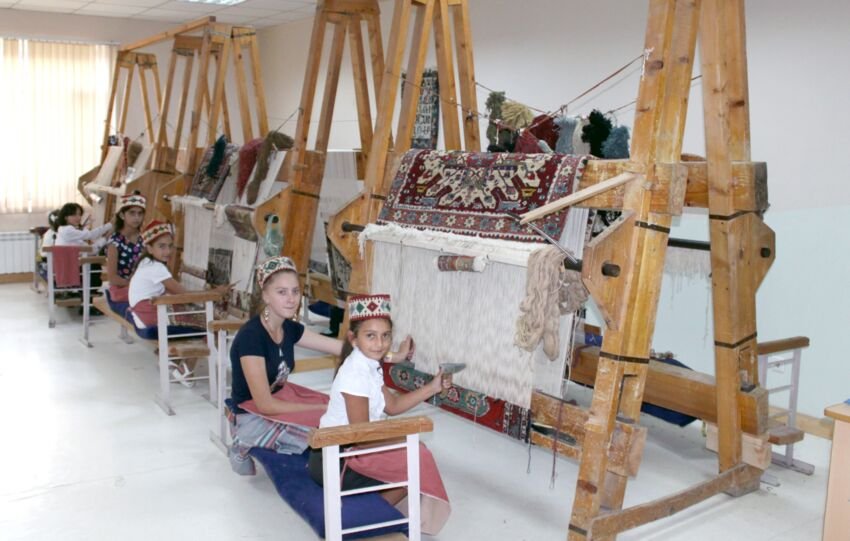
Carpet Weaving
Learners' age group: 6 to 18 years old Number of learners: Not less than 7 Volume of classes: 6 to 8 class periods per week Duration of classes: 1 class period is 45 minutes, 6-8 class periods per week Duration of study: Three years
CONTENTS
Carpet weaving is one of the traditional branches of Armenian folk art and one of the symbols of Armenian culture. In the club, students are introduced to the history of the creation of Armenian carpet weaving, the tools used, and auxiliary accessories. They study the history of art composition, learn to prepare the workspace, select ornaments and motifs, and draw and sketch handmade works. Students are presented with the characteristics of Armenian carpets, their color combinations, and the structural texture of national ornaments. By familiarizing themselves with the typical history of Armenian carpet weaving and ornaments, students appreciate Armenian culture and reflect all of this in their creative works. By studying carpet weaving as a branch of decorative and applied art, students will reinforce their professional knowledge and skills, preserve national values, and contribute to their popularization.
All necessary conditions have been created in the classroom for organizing the educational process: carpet-weaving looms, tools and equipment for obtaining and processing raw materials, the carpet-weaving torq (upright loom), and professional literature.
Report exhibitions are regularly organized to present the results of the students' work.
FORMS OF INSTRUCTION
Instruction is carried out in group and individual formats through a combination of theoretical and practical classes.
For newly admitted students, an individual approach is applied through tiered instruction, gradually involving them in the general process.
During the course of study, verbal, practical, visual methods, as well as methods developing cognitive activity and creative work, are applied. Open classes, exhibitions, educational visits, and excursions are organized, and students participate in international, republican, and city contests and festivals. Report exhibitions of the students' work are organized.
Aside from professional training, work is carried out to foster the students' moral and psychological upbringing, aesthetic development, taste formation, creative thought development, and the acquisition and strengthening of spiritual and cultural values.
EXPECTED OUTCOMES
Within the framework of the program, learners must:
-
Be able to draw and process a sketch,
-
Construct a composition and provide color solutions,
-
Master carpet-weaving techniques,
-
Correct carpet defects, and perform finishing and trimming work,
-
Be able to create independently,
-
Evaluate the completed work,
-
Preserve national values and cultural identity, and contribute to their popularization.